In today’s healthcare environment, accurate and efficient claims submission is essential for keeping revenue cycles healthy and operations running smoothly. Yet for many providers, the path from patient service to payer reimbursement is anything but simple. Insurance claims must be formatted correctly, checked for errors, transmitted securely, and tracked carefully to avoid delays or denials.
That is where a healthcare clearinghouse plays a critical role.
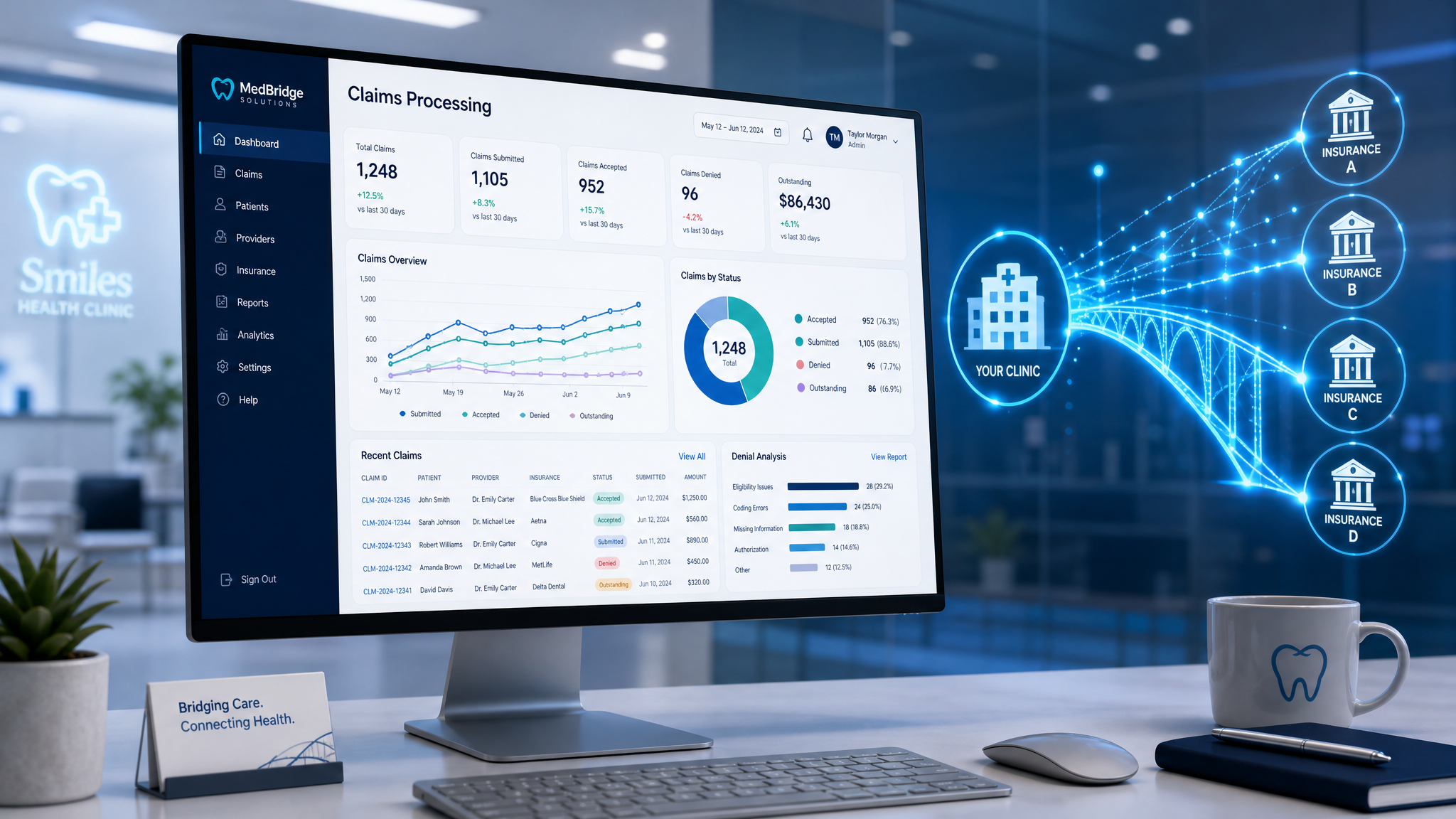
A healthcare clearinghouse acts as the bridge between healthcare providers and insurance payers, helping ensure claims are submitted in the right format and routed to the correct destination. Without this intermediary, providers would face a far more complex, error-prone, and time-consuming claims process.
This article explains what a healthcare clearinghouse is, how it works, and why it matters so much for modern claims processing clearinghouse operations.
What Is a Healthcare Clearinghouse?
A healthcare clearinghouse is an organization or platform that receives medical claims from healthcare providers, reviews and standardizes the data, and then forwards those claims to the appropriate insurance companies or government payers.
In simple terms, it serves as a translator and traffic controller for healthcare billing data.
Healthcare providers often use different practice management systems, EHRs, and billing software. Insurance payers, meanwhile, may require claims in specific electronic formats. A clearinghouse helps bridge those differences by converting claim information into standardized formats, checking for missing or incorrect data, and routing each claim to the right payer.
This makes the entire reimbursement process more streamlined and reliable.
How a Healthcare Clearinghouse Works
The role of a healthcare clearinghouse becomes clearer when you look at the steps involved in claim submission.
- Provider creates the claim
After a patient receives care, the provider documents the visit, assigns diagnosis and procedure codes, and generates a claim. - Claim is sent to the clearinghouse
Instead of sending the claim directly to each payer, the provider submits it electronically to the clearinghouse. - Claim is reviewed and scrubbed
The clearinghouse checks the claim for formatting issues, invalid codes, missing information, and payer-specific requirements. - Claim is standardized
The claim is converted into the proper electronic format required for processing, often following HIPAA-compliant transaction standards. - Claim is routed to the payer
Once validated, the clearinghouse forwards the claim to the correct insurance company, Medicare, Medicaid, or other payer. - Responses are returned to the provider
The clearinghouse can also send back claim acknowledgments, rejection notices, remittance advice, and status updates.
Because of this workflow, a claims processing clearinghouse reduces friction between providers and payers while improving submission quality.
Why a Healthcare Clearinghouse Matters for Claims Processing
Claims processing is one of the most important functions in the healthcare revenue cycle. Even small errors can cause denials, delayed reimbursements, and administrative burdens. A healthcare clearinghouse matters because it directly improves the speed, accuracy, and efficiency of claim submission.
Here are some of the main reasons it is so important.
1. Reduces Claim Errors Before Submission
One of the biggest advantages of using a healthcare clearinghouse is claim scrubbing. Before a claim ever reaches a payer, the clearinghouse checks for common issues such as:
- Missing patient demographics
- Invalid insurance information
- Incorrect provider identifiers
- Coding mismatches
- Formatting errors
- Incomplete claim fields
By catching these errors early, providers can correct them before submission. This significantly lowers rejection rates and helps prevent avoidable payment delays.
2. Improves Speed and Efficiency
Submitting claims manually to multiple payers is time-consuming and inefficient. A healthcare clearinghouse allows providers to submit claims through a single connection rather than dealing with each payer separately.
This centralized workflow saves time for billing teams and accelerates the claims cycle. Faster submission usually means faster adjudication and, ultimately, faster payment.
For healthcare organizations managing high claim volumes, this efficiency can make a major difference in cash flow.
3. Simplifies Payer Connectivity
Insurance companies often have different requirements, formats, and submission rules. Without a clearinghouse, providers may need to maintain multiple payer portals or system integrations.
A claims processing clearinghouse simplifies this complexity by acting as a single access point. Providers submit claims once, and the clearinghouse handles the routing and formatting needed for each payer.
This not only reduces administrative work but also makes it easier for practices to scale operations without increasing billing friction.
4. Enhances Revenue Cycle Performance
A stronger claims process leads to a stronger revenue cycle. When claims are clean, timely, and correctly routed, providers are more likely to receive reimbursement without unnecessary delays.
A healthcare clearinghouse supports revenue cycle improvement by helping organizations:
- Increase first-pass claim acceptance rates
- Reduce denials and rework
- Shorten reimbursement timelines
- Improve billing staff productivity
- Gain better visibility into claim status
Over time, these improvements can have a direct impact on financial stability and operational performance.
5. Supports Compliance and Standardization
Healthcare billing requires strict adherence to data and transaction standards. Clearinghouses help providers stay aligned with HIPAA requirements and industry-standard electronic data interchange formats.
By standardizing claim transactions and supporting secure transmission, a healthcare clearinghouse contributes to a more compliant and reliable process. This is especially important in an industry where privacy, accuracy, and documentation standards are critical.
Common Transactions Handled by a Healthcare Clearinghouse
Although claims submission is a core function, many clearinghouses support a wider range of electronic transactions. These may include:
- Eligibility verification
- Claim status inquiries
- Electronic remittance advice
- Payment transactions
- Prior authorization support
- Referral processing
This broader functionality makes the clearinghouse an important part of the overall administrative and billing ecosystem, not just a claim submission tool.
Who Uses a Healthcare Clearinghouse?
A healthcare clearinghouse can be valuable for many types of healthcare organizations, including:
- Independent physician practices
- Medical billing companies
- Hospitals and health systems
- Urgent care centers
- Specialty clinics
- Behavioral health providers
- Dental and allied health organizations
Any provider that submits insurance claims electronically can benefit from the added accuracy, speed, and simplification a clearinghouse provides.
Key Benefits of Choosing the Right Claims Processing Clearinghouse
Not all clearinghouses offer the same level of service, flexibility, or technology. Choosing the right claims processing clearinghouse can have a meaningful effect on your billing outcomes.
When evaluating options, providers often look for:
- Strong payer network coverage
- Real-time claim scrubbing
- Easy integration with EHR or billing software
- Transparent reporting and analytics
- Reliable customer support
- Secure and compliant data handling
- Fast turnaround times for claim responses
A dependable clearinghouse should not only transmit claims but also help providers optimize their workflows and reduce billing challenges.
Challenges Providers Face Without a Clearinghouse
Without a healthcare clearinghouse, providers may face a number of avoidable obstacles, such as:
- Higher claim rejection rates
- More manual work for staff
- Delayed reimbursements
- Difficulty managing multiple payer requirements
- Reduced visibility into claim issues
- Increased administrative costs
In a healthcare landscape where margins are tight and staffing pressures are real, these inefficiencies can quickly add up.
The Bottom Line
A healthcare clearinghouse is much more than a technical middleman. It is a critical partner in ensuring claims move efficiently, accurately, and securely from providers to payers. By reducing errors, simplifying payer communication, and improving reimbursement workflows, a clearinghouse plays a central role in successful claims management.
For healthcare organizations looking to strengthen billing operations, reduce denials, and improve cash flow, working with the right claims processing clearinghouse is an essential step.
As claims processing continues to evolve, the importance of reliable clearinghouse support will only grow. Providers that invest in streamlined, technology-driven claim workflows are better positioned to reduce administrative burden and focus more of their energy where it belongs: on patient care.