In the complex ecosystem of modern healthcare administration, the financial stability of a practice is often determined by the efficiency of its back-office operations. For healthcare administrators and providers, navigating the terminology of the revenue cycle can be confusing. Two terms that are frequently used in the same breath but serve vastly different purposes are “clearinghouse” and “billing service.”
In the clearinghouse vs billing service debate, the distinction is fundamentally one of technology versus labor. While a clearinghouse offers the digital infrastructure to move data, a billing service provides the professional workforce to manage the lifecycle of a claim. Understanding these nuances is critical for healthcare teams aiming to optimize their reimbursements and decrease administrative friction.
What Is a Healthcare Clearinghouse?
A healthcare clearinghouse is an electronic intermediary that sits between the healthcare provider’s practice management software and the insurance payer. Its primary function is to translate and transmit health information in a secure, standardized format (HIPAA-compliant EDI standards).
When a claim is submitted, the clearinghouse performs a process known as “claim scrubbing.” This automated check scans for technical errors such as:
- Incorrect patient demographics or subscriber IDs.
- Invalid CPT or ICD-10 codes.
- Mismatched NPI numbers or tax IDs.
- Incomplete mandatory fields required by specific payers.
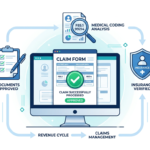
The clearinghouse is essentially a secure mailbox that checks to make sure the envelope is addressed correctly before it hits the payer’s system. It provides the software-as-a-service (SaaS) foundation required for modern electronic billing.
What Is a Medical Billing Service?
A medical billing service is an outsourced company that takes over the actual work of the billing department. Rather than providing just a software tool, they provide a team of billing specialists, coders, and follow-up experts.
A billing service’s responsibilities often start before the patient even walks through the door and continue long after the claim is sent. This model is highly effective for practices undergoing clinical expansion. For example, as practices grow and bring on more providers through resources like NP Collaborator to fulfill state-mandated supervision, the sudden influx of claims can overwhelm a small front-desk staff. A billing service absorbs this extra volume, managing everything from charge entry to patient statements.
Clearinghouse vs Billing Service: A Side-by-Side Comparison
To determine which model fits your practice, it is helpful to look at where the responsibility lies for key revenue cycle tasks:
| Feature/Task | Healthcare Clearinghouse | Medical Billing Service |
|---|---|---|
| Tools vs. Talent | Purely a software/technology tool. | A team of professionals (labor). |
| Claim Creation | Done by your in-house staff. | Done by the billing service team. |
| Denial Management | Only alerts you that a denial happened. | Investigates, corrects, and appeals the denial. |
| Patient Collections | Not handled; purely insurance-focused. | Often manages patient statements and calls. |
| Cost Structure | Usually a flat monthly fee or per-claim fee. | Typically a percentage of total collections. |
| Payer Relations | Provides the electronic connection. | Calls payers to resolve complex issues. |
How They Work Together in the Revenue Cycle
It is a mistake to think you must always choose one or the other. In reality, most medical billing services utilize a clearinghouse to perform their work. The clearinghouse provides the digital highway, and the billing service drives the car.
For large organizations with a robust, highly trained in-house team, subscribing directly to a clearinghouse provides the maximum amount of control. However, for independent practices—particularly those led by Nurse Practitioners who are utilizing npcollaborator to launch their own clinical sites—a full-service billing partner is often the more scalable choice. This allows the practitioner to focus 100% on patient care while the billing service handles the “dirty work” of insurance follow-ups.
The Limitations of “Scrubbing” vs. Real Expertise
One of the most common pitfalls practices face is over-relying on a clearinghouse’s automated edits. While a clearinghouse can tell you if a field is empty, it cannot tell you if your clinical documentation justifies the level of service billed.
A medical billing service comparison often highlights the “human element.” A human biller can:
- Identify patterns in why a specific payer is suddenly denying claims.
- Navigate the nuances of new “No Surprises Act” regulations.
- Negotiate with insurance representatives to overturn wrongful denials.
- Provide feedback to providers on how to improve documentation to maximize legitimate revenue.
If your “clean claim” rate is high at the clearinghouse level, but your actual bank deposits are low, you likely have a follow-up problem that a software tool alone cannot fix. For deeper strategies on this, see our Denied Claims Resolution Guide.
Choosing the Right Path for Your Practice
When deciding between these two, ask your team the following questions:
- Do we have the staff? If you have a dedicated biller who has been with you for years, a clearinghouse is likely all you need.
- What is our volume? Low-volume practices may find the percentage-based cost of a billing service more affordable than the flat fees of some clearinghouses.
- Are our denials under control? If you are losing more than 5% of your revenue to denials, you may need the professional intervention of a billing service.
For more information on the technological side of the industry, explore our comparison of the Top Healthcare Clearinghouse Software Platforms.
Final Takeaway
The clearinghouse vs billing service choice isn’t just about cost—it’s about where you want your team to spend their time. A clearinghouse empowers your team to do the work themselves more efficiently. A billing service takes the work off your plate entirely.
By aligning your administrative infrastructure with your clinical growth and staffing capabilities, you can ensure that your practice remains financially healthy while delivering the highest standard of patient care.