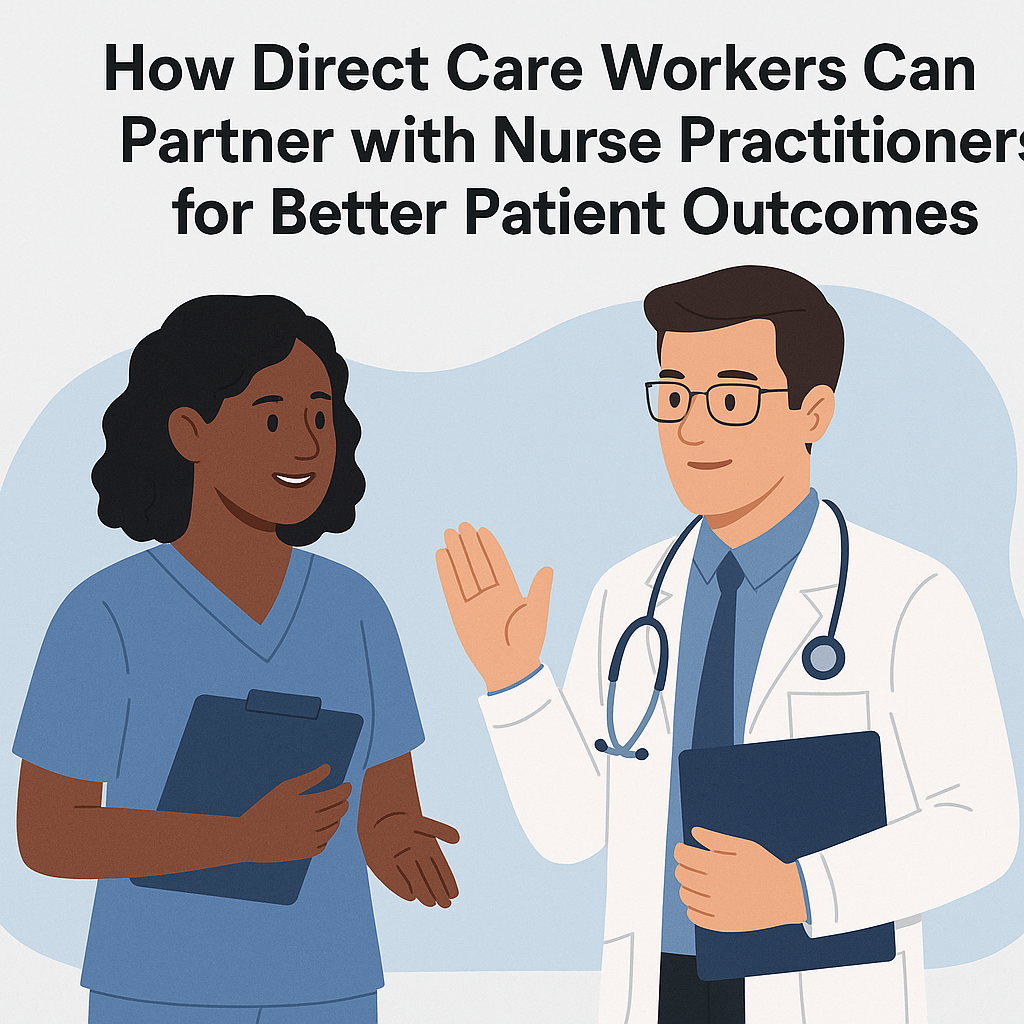
Direct care workers spend more time with patients than almost any other healthcare professional. Nurse practitioners bring advanced clinical expertise and decision-making capabilities. When the two collaborate effectively, the result is improved care quality, faster recovery, and higher patient satisfaction. This guide explains how direct care workers and NPs can work together, highlighting communication methods, practical collaboration models, and real-world examples to help care teams deliver better outcomes.
Direct care workers can significantly improve patient outcomes by partnering with nurse practitioners through effective communication, shared care planning, real-time reporting of patient changes, and participation in collaborative care models. Leveraging tools like digital monitoring, structured care meetings, and case-based collaboration ensures patient safety and timely interventions.
Table of Contents
- Why collaboration between direct care workers and NPs matters
- Key roles and responsibilities explained
- Practical collaboration strategies
- Communication and reporting framework
- Collaborative care models
- Real-time scenario: A case study
- Use of digital tools and technology
- Benefits of NP–direct care worker partnerships
- Training and skill development
- How to start collaboration at your facility
- Final thoughts
1. Why Collaboration Matters
Direct care workers are the foundation of daily patient interaction. They notice subtle changes in patient behavior, mood, habits, or physical condition. Nurse practitioners (NPs), meanwhile, provide advanced assessment, diagnosis, prescribing, and care planning.
When both roles align:
- Patient deterioration is addressed early
- Hospital readmissions reduce
- Patients receive holistic care
- Workload becomes balanced and sustainable
- Care compliance increases
A partnership approach between direct care workers and NPs resolves fragmented care and ensures continuity.
2. Roles and Responsibilities
| Role | Primary Responsibility | Point of Collaboration |
|---|---|---|
| Direct Care Workers | Daily patient assistance, recording vitals, observing changes | Report immediate concerns to NPs |
| Nurse Practitioners | Diagnosis, prescribing treatment, clinical decision making | Guide care workers on protocol |
Secondary roles both share:
- Educating family members
- Ensuring safety and hygiene
- Coordinating follow-up care
3. Practical Collaboration Strategies
Here’s how to create a seamless partnership:
✓ Daily verbal huddles
Start each shift with a 5-minute check-in between direct care staff and the NP.
✓ Structured Reporting Sheet
Direct care workers update vitals, mobility, hydration, mood, and appetite using standardized forms reviewed by NPs.
✓ Patient priority list
Create a color-coded urgency system.
| Color | Status |
|---|---|
| 🔴 | High risk – alert NP immediately |
| 🟠 | Moderate change – review same shift |
| 🟢 | Stable – monitor regularly |
4. Effective Communication Framework
SBAR Method (widely used in healthcare):
- S – Situation: Patient refusing meals.
- B – Background: Diabetic, previous appetite issues.
- A – Assessment: Increased lethargy.
- R – Recommendation: NP review and possible glucose test.
Training direct care workers to use SBAR improves clarity and prevents delays.
5. Collaborative Care Models
| Care Model | Outcome |
|---|---|
| NP-led supervision with direct care worker inputs | High patient engagement |
| Interdisciplinary team meetings with NP + DCW | Reduced medication errors |
| Telehealth NP guidance with local care worker support | Effective for remote/elderly |
6. Case Study: Improving Wound Recovery
Location: Midwest care facility
Patient: 78-year-old post-surgical recovery
Team: NP supervises care worker
Process:
- Care worker noticed increased leg swelling and localized warmth.
- Reported to NP using SBAR.
- NP ordered immediate ultrasound → diagnosed deep vein thrombosis (DVT).
- Treatment started within 3 hours.
👉 Result: Complication prevented and patient discharged safely.
7. Technology-Enabled Collaboration
| Tool Type | How It Helps |
|---|---|
| Digital health tracking | Logs vitals in real time |
| Secure messaging apps | DCWs send alerts to NPs instantly |
| EHR integration | Shared patient care notes |
| Remote video consultations | NPs check high-risk cases remotely |
8. Benefits of DCW–NP Collaboration
- 📉 40% fewer hospital readmissions
- ⏱ Faster care adjustments
- 🙋♀️ Patient-centered care improves
- 💬 Better patient-family communication
- 🧠 Increased knowledge sharing
- 💼 Reduces burnout across staff
9. Training and Skill Development
Direct Care Workers should be trained in:
- Basic clinical observation
- Documentation accuracy
- SBAR communication
- Emotional intelligence and patient engagement
Nurse Practitioners should be trained in:
- Delegation techniques
- Mentorship
- Non-clinical leadership
Encourage job shadowing and workshops to build synergy.
10. How to Start Collaboration at Your Facility
| Step | Action |
|---|---|
| 1 | Define NP–DCW communication protocol |
| 2 | Introduce reporting tools/forms |
| 3 | Conduct joint weekly patient review |
| 4 | Assign collaboration lead |
| 5 | Implement performance tracking |
11. Final Thoughts
Direct care workers are the eyes and ears of patient welfare, while nurse practitioners are the decision-makers who turn observations into actionable care plans. A strong partnership supported by structured communication, technology, and mutual respect drives positive outcomes and creates a safer, more responsive healthcare environment.
If you’re a care facility manager or healthcare professional looking to improve patient outcomes, start by improving the connection between your direct care workers and nurse practitioners.