In the demanding environment of long-term care (LTC), effective delegation is not just a management skill—it is a cornerstone of patient safety and quality resident outcomes. Registered Nurses (RNs) in LTC settings constantly balance clinical responsibility with the practical needs of a complex and often understaffed environment.
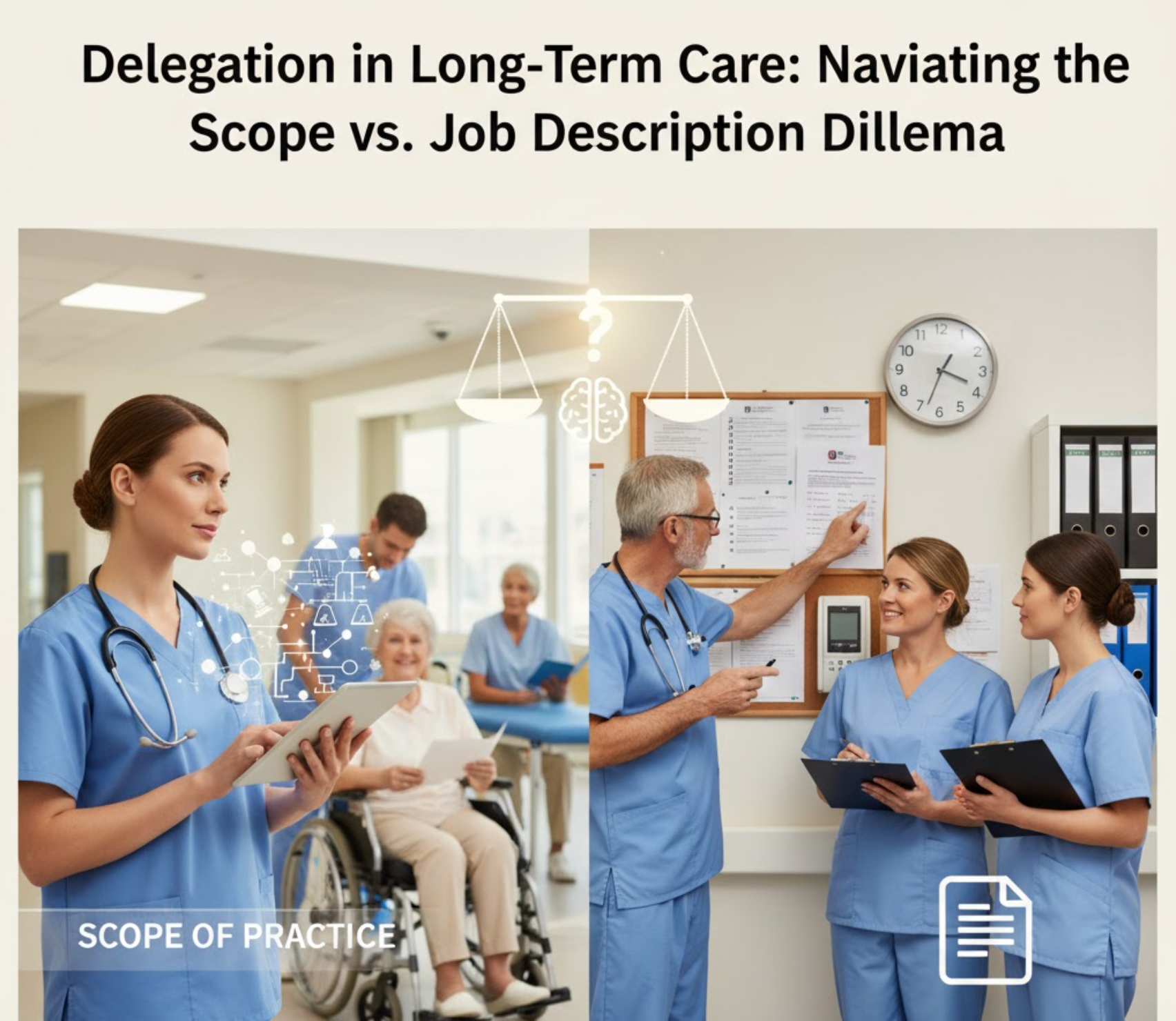
But when an RN decides who does what, where does the ultimate authority lie: in the legal framework of their license or in the facility’s policy manual? This crucial question—Delegation in Long-Term Care: Scope of Practice or Job Description?—was explored in a key study published in the OJIN: The Online Journal of Issues in Nursing. The findings reveal that RNs essentially use two different, and sometimes conflicting, strategies.
The Two Lenses of Delegation
The study of RN leaders in institutional long-term care found that nurses primarily employed one of two distinct approaches when delegating tasks to Licensed Practical Nurses (LPNs) and Unlicensed Assistive Personnel (UAPs):
1. The “Follow the Job Description” Approach 📄
This strategy centers on operational certainty. RNs who follow this approach emphasize strict adherence to facility-level roles and the job descriptions of their staff.
- Pros: It provides a clear, defined boundary for tasks, reducing ambiguity and increasing certainty for the delegating RN. It aligns directly with facility compliance and policy.
- Cons: This approach risks becoming inflexible. If a job description is outdated or too restrictive, it may hinder the RN’s ability to respond dynamically to complex, changing resident needs, potentially overlooking an opportunity for appropriate task shifting.
2. The “Consider the Scope of Practice” Approach ⚖️
This strategy is anchored in professional and legal responsibility. RNs using this method consider multiple factors: the state’s Nurse Practice Act, the licensure of the delegatee, the complexity of the task, the condition of the resident, and the overall context of care. This approach utilizes the “Five Rights of Delegation” (Right Task, Right Circumstance, Right Person, Right Direction/Communication, Right Supervision).
- Pros: This holistic, context-specific view directly facilitates a focus on quality of resident-care outcomes. It allows the RN to make the most informed, ethical, and safe decision based on clinical judgment, not just organizational rules.
- Cons: It can introduce more complexity and uncertainty for the RN, as it requires deeper critical thinking and documentation to justify decisions outside of a simple checklist.
The Critical Takeaway: Integrating Both for Quality
The study suggests that while relying solely on the job description offers clarity, it is the consideration of scope of practice that links the delegation process most strongly to resident safety and quality outcomes.
For delegation to be truly effective in long-term care, RNs must integrate both frameworks. The job description provides the floor—the basic, accepted tasks an individual is trained and hired to do. The scope of practice, however, provides the ceiling—the legal and professional boundary that cannot be crossed, regardless of what a job description might mistakenly permit.
Ultimately, the delegating RN remains accountable for the outcomes of the care. Therefore, the safest and most professional practice requires a critical thinking process that starts with the legal scope of practice and uses the job description as a tool for operational implementation. When these two align, delegation not only frees the RN to handle complex clinical issues but also ensures that every resident receives the right care, from the right person, at the right time.