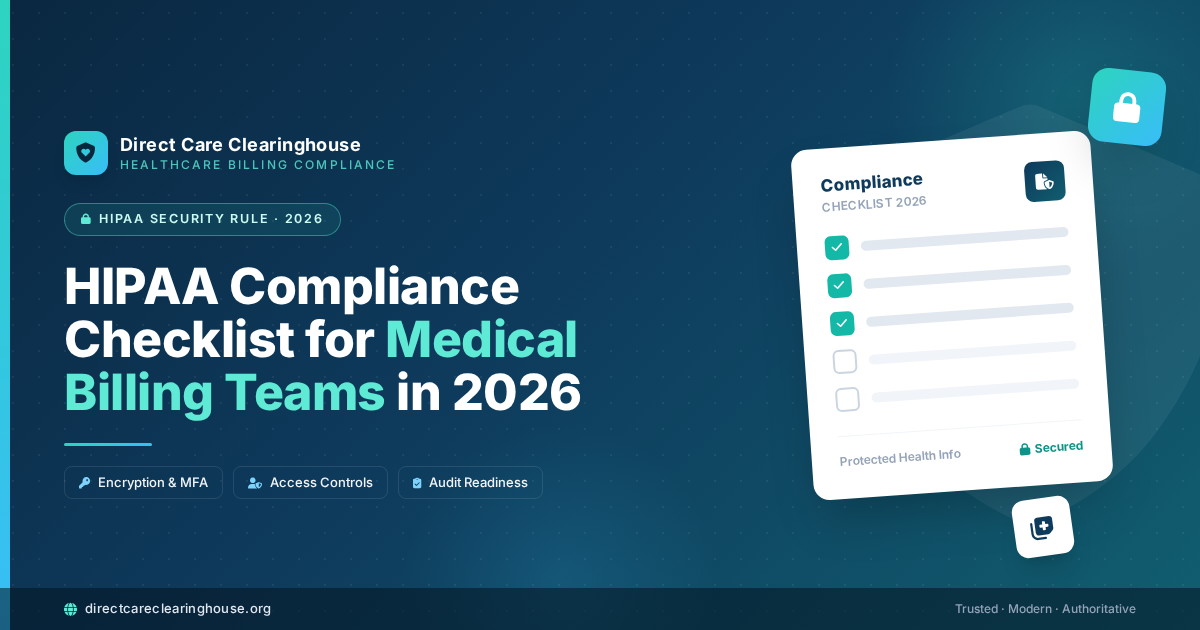
Medical billing teams sit at the crossroads of patient data and financial operations, handling everything from insurance claims to payment records loaded with electronic Protected Health Information (ePHI). That position makes them a prime target for both cyberattacks and regulatory scrutiny. With the Office for Civil Rights (OCR) resolving a record number of enforcement actions and the Department of Health and Human Services (HHS) pushing a major Security Rule overhaul, 2026 is the year to pressure-test every layer of your compliance program.
This checklist is built for billing managers, compliance officers, and practice administrators who need a single, actionable reference — not a 200-page policy manual. Work through it section by section, and you’ll walk into any audit or risk review with confidence.
1. Conduct a Comprehensive Security Risk Assessment
A thorough risk assessment is the foundation of every HIPAA compliance program, and it remains the single most common deficiency cited in OCR investigations. For billing teams, the scope extends far beyond the EHR.
Action items:
- Map every system, application, and device that touches ePHI in the billing workflow — from practice management software and clearinghouse portals to staff workstations and mobile devices.
- Identify potential threats (ransomware, phishing, insider misuse) and vulnerabilities (unpatched software, weak passwords, unsecured Wi-Fi).
- Rate each risk by likelihood and potential impact, then document your mitigation plan for every finding.
- Repeat the full assessment at least annually, or whenever your billing infrastructure changes significantly (new vendor, system migration, office relocation).
- Retain all risk assessment documentation for a minimum of six years from the date of creation or last effective date.
A risk assessment that only covers clinical systems while ignoring billing platforms, clearinghouse connections, and payment terminals leaves a dangerous gap. Make sure your scope is complete.
2. Enforce Encryption Everywhere
Encryption has shifted from a best practice to a baseline expectation. Under the proposed 2026 Security Rule update, mandatory encryption of ePHI — both at rest and in transit — is a central requirement. Even before the rule is finalized, OCR already views the absence of encryption as a serious compliance failure.
Action items:
- Encrypt all stored ePHI using AES-256 or another NIST-approved algorithm — this includes databases, backups, local files, and portable media.
- Secure data in transit with TLS 1.2 or higher across every connection: clearinghouse submissions, payer portals, email communications, and remote access sessions.
- Verify that your cloud-based billing software and any third-party platforms encrypt data on their end as well; document their encryption methods.
- Disable legacy protocols (SSL, TLS 1.0/1.1) on all systems connected to billing workflows.
- Establish an encryption key management policy covering key generation, rotation, storage, and revocation.
If a laptop containing unencrypted billing data is stolen, you have a reportable breach. If that same data was properly encrypted, you may qualify for the HIPAA breach notification safe harbor. Encryption is both a compliance measure and an insurance policy.
3. Implement Multi-Factor Authentication (MFA)
The proposed 2026 Security Rule explicitly mandates MFA for all access to ePHI, with only narrow exceptions for certain medical devices. Regardless of the final rule’s timeline, MFA is one of the most effective defenses against credential-based attacks — the leading vector in healthcare data breaches.
Action items:
- Enable MFA on every system that accesses ePHI: practice management platforms, billing software, clearinghouse portals, email accounts, VPNs, and remote desktop sessions.
- Choose strong second factors — authenticator apps or hardware tokens are preferred over SMS-based codes, which are vulnerable to SIM-swapping attacks.
- Apply MFA to administrative and privileged accounts without exception.
- Test your MFA rollout with a pilot group before expanding to the full billing team, and document the implementation process.
4. Lock Down Access Controls
The HIPAA “minimum necessary” standard requires that each team member can access only the ePHI they need to perform their specific job function. Overbroad access permissions are a compliance risk and a breach amplifier.
Action items:
- Implement role-based access controls (RBAC) across all billing systems. A coder should not have the same access as a billing manager, and neither should have access to clinical notes beyond what’s needed for claims support.
- Assign each user a unique login — shared credentials make it impossible to maintain audit trails and violate HIPAA access control standards.
- Establish a formal process to terminate or modify access within one hour when an employee is terminated, changes roles, or no longer needs access to billing systems.
- Review user access rights at least quarterly and immediately after any staffing change.
- Implement automatic session timeouts on all workstations and applications after a defined period of inactivity (industry standard is 10–15 minutes).
5. Manage Business Associates and Vendor Relationships
Outsourcing billing functions does not outsource HIPAA liability. As a covered entity, your practice remains responsible for claims submitted under its National Provider Identifier (NPI), and you are accountable for ensuring your vendors protect ePHI.
Action items:
- Maintain an up-to-date Business Associate Agreement (BAA) with every third party that creates, receives, maintains, or transmits ePHI on your behalf — including billing companies, clearinghouses, IT providers, cloud storage vendors, shredding services, and collections agencies.
- Ensure BAAs include explicit clauses covering encryption requirements, MFA obligations, breach notification timelines (the proposed rule calls for 24-hour incident reporting to covered entities), and the right to audit.
- Request written verification from each business associate confirming that required technical safeguards are deployed.
- Review and update all BAAs annually or whenever a vendor’s services or security posture change.
- Maintain a centralized vendor inventory with contract dates, BAA status, and last-reviewed dates.
If a business associate experiences a breach involving your patients’ data, the liability chain leads back to you. Proactive vendor management is non-negotiable.
6. Train Your Billing Staff — and Document Everything
Human error remains the leading cause of HIPAA violations. Billing teams face unique risks: phishing emails disguised as payer communications, social engineering calls requesting patient financial data, and the temptation to take shortcuts during high-volume claim cycles.
Action items:
- Provide formal HIPAA training to all billing staff upon hiring and at least annually thereafter.
- Tailor training content to billing-specific scenarios: recognizing phishing attempts targeting billing portals, handling payment disputes without over-disclosing PHI, applying the minimum necessary standard when responding to payer requests, and properly de-identifying data for reporting.
- Conduct periodic phishing simulations to test staff awareness and identify employees who need additional coaching.
- Keep detailed training logs — including dates, topics covered, attendee names, and assessment results — for at least six years. These records are among the first documents an auditor will request.
- Post quick-reference compliance reminders at workstations covering topics like clean desk policy, screen-lock procedures, and secure fax/email protocols.
7. Build and Test a Breach Response Plan
A data breach involving billing records can expose Social Security numbers, insurance information, and financial data. The window between discovery and required notification is tight, and the reputational damage from a fumbled response can outlast the financial penalties.
Action items:
- Maintain a written incident response plan that clearly defines roles, responsibilities, escalation procedures, and communication templates.
- Under the HIPAA Breach Notification Rule, notify affected individuals, HHS, and (for breaches affecting 500+ individuals) the media within 60 days of discovering a breach.
- The proposed Security Rule update would require notifying covered entities of a business associate’s contingency plan activation within 24 hours — build this timeline into your BA contracts now.
- Conduct a tabletop exercise at least once per year simulating a billing-specific breach scenario (e.g., a ransomware attack on your practice management system or a misdirected batch of EOBs).
- After any actual incident, perform a root-cause analysis and update policies, training, and technical controls accordingly.
8. Maintain Rigorous Audit Trails
Audit logs serve as both a detective control and your best evidence during an investigation. For billing teams, they answer critical questions: Who accessed a patient’s billing record? When? What did they change?
Action items:
- Enable comprehensive audit logging on all systems that store or process ePHI — practice management software, billing platforms, clearinghouse portals, and file servers.
- Capture user logins, failed login attempts, record access events, data exports, claim modifications, and permission changes.
- Review audit logs at least monthly to identify suspicious patterns such as after-hours access, bulk record queries, or access by terminated users.
- Protect log integrity by storing logs in a tamper-resistant format and restricting modification access.
- Retain audit logs for a minimum of six years, consistent with HIPAA documentation requirements.
9. Run Vulnerability Scans and Penetration Tests
Cybercriminals increasingly target healthcare billing systems because they house both medical and financial data. Regular testing helps you find weaknesses before an attacker does.
Action items:
- Perform vulnerability scans on all billing-related systems at least every six months (the proposed 2026 rule’s recommended cadence).
- Conduct a formal penetration test at least annually, performed by a qualified internal team or independent third party.
- Prioritize and remediate findings based on severity — critical and high-risk vulnerabilities should be patched within 30 days.
- Document all scan results, remediation actions, and retest confirmations.
- Include endpoints commonly overlooked in billing environments: fax servers, legacy clearinghouse integrations, and multi-function printers with scan-to-email capability.
10. Uphold Patient Rights and Billing Transparency
HIPAA’s Right of Access initiative remains a top enforcement priority for OCR. Patients have the right to obtain copies of their billing and medical records, and penalties for non-compliance have been swift.
Action items:
- Respond to patient record requests within 30 days (a one-time 30-day extension is permitted with written justification).
- Provide records in the format the patient requests (electronic or paper) whenever feasible.
- Charge only for the actual cost of production (paper, postage, electronic media) — never for staff time spent searching for or retrieving records.
- Provide itemized, plain-language billing statements in alignment with the No Surprises Act’s transparency requirements.
- Offer pre-service cost estimates for non-emergency scheduled services.
- Train front-desk and billing staff on how to process access requests without unnecessary delays or roadblocks.
11. Perform Quarterly Internal Compliance Audits
Don’t wait for an OCR investigation to discover compliance gaps. A structured internal audit program catches problems early and demonstrates good faith.
Action items:
- Conduct internal audits at least quarterly, focusing on high-risk billing areas: modifier usage, telehealth documentation and billing, prior authorization compliance, and timely filing.
- Audit a random sample of claims each cycle to verify that clinical documentation supports every billed CPT and ICD-10 code.
- Review coding patterns for red flags such as upcoding, unbundling, and duplicate billing.
- Document audit findings, corrective action plans, and follow-up verification in a centralized compliance log.
- Report audit results to practice leadership and use findings to update training content and policies.
12. Stay Ahead of the Proposed 2026 Security Rule
On January 6, 2025, HHS published a Notice of Proposed Rulemaking (NPRM) that would represent the most significant update to the HIPAA Security Rule in over a decade. While the rule has not been finalized — the public comment period closed in March 2025 with nearly 5,000 comments, and finalization is now projected for 2027 — the direction of travel is clear. Billing teams that begin preparing now will avoid a scramble when the compliance clock starts.
Key proposals to prepare for:
- Elimination of “addressable” specifications: All security controls would become mandatory, removing the ability to document alternatives in lieu of implementation.
- Technology asset inventories: Organizations would need to maintain a current, documented inventory of all technology assets and a network map showing ePHI flow.
- Network segmentation: Explicit requirements to segment ePHI systems to limit lateral movement during a breach.
- 72-hour system restoration: Contingency plans must be capable of restoring critical systems within 72 hours of an outage.
- Annual compliance audits: A formal, documented audit of all Security Rule standards every 12 months.
- 240-day compliance window: If finalized as proposed, organizations would have 240 days from the rule’s publication to achieve full compliance.
Even if portions of the proposed rule are scaled back, the underlying message from HHS is unmistakable: the era of optional security controls in healthcare is over. Every item in this checklist positions your billing team to meet both current requirements and whatever comes next.
Final Thought
HIPAA compliance for medical billing teams isn’t a one-time project — it’s an ongoing discipline. The practices that avoid penalties and breaches are the ones that treat compliance as a daily operational habit rather than an annual checkbox. Use this checklist as your roadmap, revisit it regularly, and build a culture where protecting patient data is simply how your team works.