Healthcare organizations lose time and revenue when claims are rejected for avoidable reasons—missing data, coding mismatches, eligibility issues, or payer-specific formatting requirements. A healthcare clearinghouse acts as the “quality control + routing hub” between providers and payers, helping catch errors early, standardize claim files, and improve first-pass acceptance rates.
This article explains the healthcare clearinghouse benefits that directly support claim rejection reduction, along with practical examples of where rejections happen and how a clearinghouse helps prevent them.
What is a healthcare clearinghouse (in plain terms)?
A healthcare clearinghouse is an intermediary that receives claims from providers, checks them for common errors and payer rules, converts them into standardized electronic formats (like ANSI X12 837), and forwards them to the appropriate payer. It also returns payer responses—acknowledgments, rejections, and remittance info—back to the provider.
Instead of sending claims to every payer in different ways, providers send to the clearinghouse once, and the clearinghouse helps manage the complexity.
Why claims get rejected (and why “small” errors matter)
Claim rejections often happen for reasons that are technically simple but operationally costly:
- Patient demographics don’t match payer records (name spelling, DOB, member ID, address)
- Invalid or missing diagnosis/procedure codes (ICD-10/CPT/HCPCS issues)
- Missing required fields (referring provider NPI, place of service, modifiers)
- Eligibility not active on date of service
- Authorization/referral missing
- Payer-specific rules not satisfied (formatting, code combinations, frequency limits)
- Duplicate claim flags due to timing or incorrect resubmission workflows
Each rejection creates rework: staff must research, correct, and resubmit—delaying reimbursement and increasing administrative burden.
How clearinghouses drive claim rejection reduction
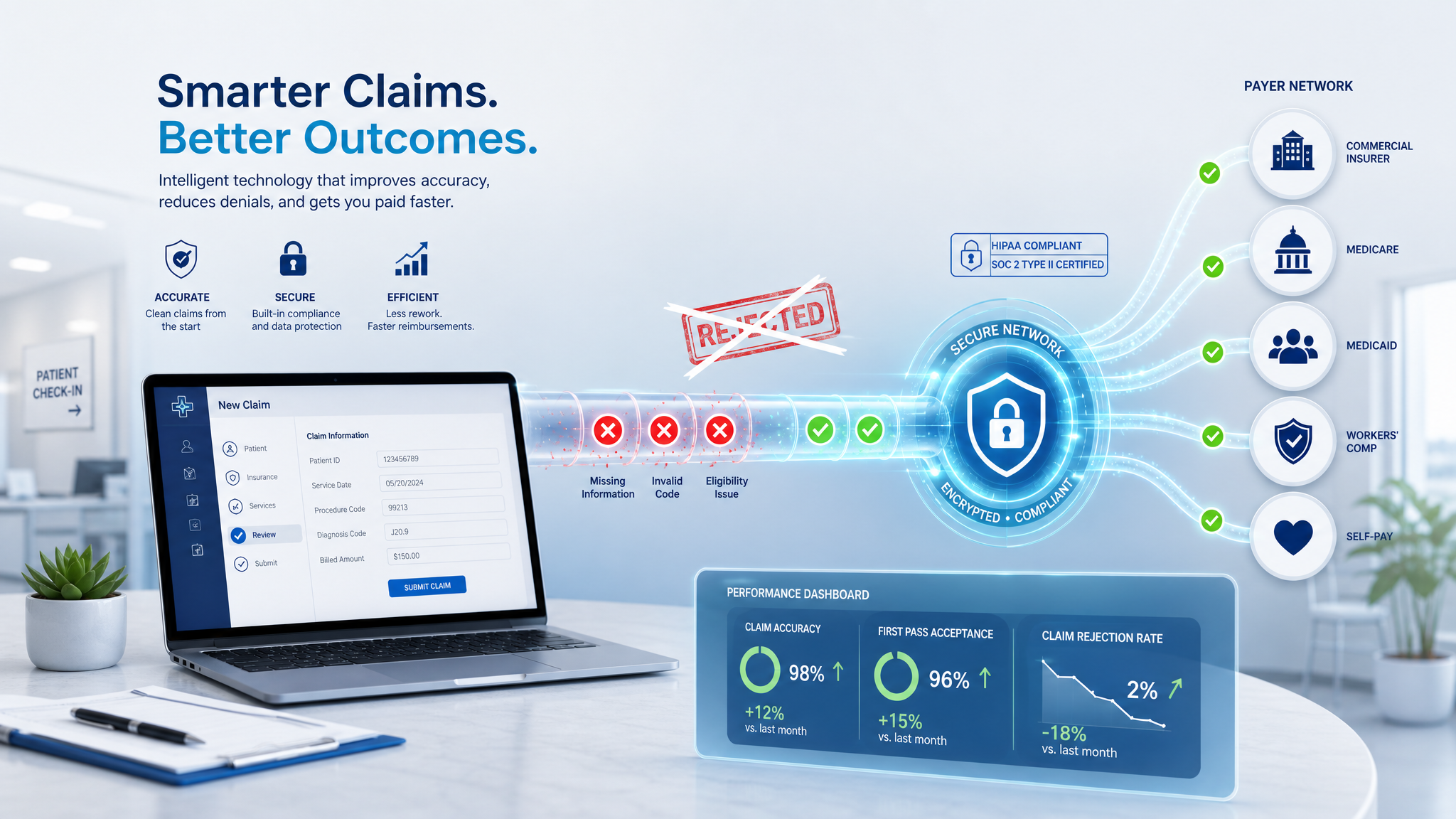
A clearinghouse reduces rejections by improving claim accuracy before the claim hits the payer.
1) Automated claim scrubbing (error detection before submission)
One of the biggest healthcare clearinghouse benefits is claim scrubbing—automated checks that validate claims against:
- Standard EDI requirements (format + required segments)
- Basic coding logic (invalid codes, missing modifiers, incompatible combinations)
- Payer edits (payer-specific rules that commonly trigger rejections)
Impact: Instead of learning about errors after a payer rejects a claim, you catch and fix many of them upfront—supporting better first-pass outcomes.
2) Clean EDI formatting and standardization
Even when the clinical/coding data is correct, claims can fail due to formatting or EDI structure issues. Clearinghouses help by:
- Converting claims into payer-ready EDI formats
- Ensuring required loops/segments are included
- Validating structure so the payer system can ingest the claim
Impact: Fewer “technical rejections” that have nothing to do with medical necessity—just data packaging.
3) Faster feedback loops with acknowledgments and rejection details
Clearinghouses typically relay key EDI responses (commonly 999 and 277CA acknowledgments for many workflows). These responses can help you see:
- Whether the claim was accepted for processing
- Whether it was rejected early and why
- Which fields triggered the rejection
Impact: Faster visibility = quicker corrections and resubmissions, preventing aging A/R from avoidable delays.
4) Better payer connectivity (less fragmentation)
Many practices struggle because each payer has different submission requirements, portals, and workflows. A clearinghouse reduces that complexity by offering a more unified path to multiple payers.
Impact: More consistent submissions, fewer process mistakes, and less staff time lost switching systems.
5) Eligibility and coverage checks (prevent “inactive coverage” denials)
A major driver of downstream denials (or immediate rejections in some payer flows) is eligibility problems. While eligibility checking may depend on your workflow and integrations, it’s a common area where clearinghouse-supported processes help teams verify coverage earlier.
Impact: Fewer claims sent when coverage isn’t active or information is incomplete—saving rework.
How clearinghouses improve overall accuracy (not just “acceptance”)
Reducing rejections is critical, but accuracy improvements go further:
- Cleaner demographic and insurance data over time (fewer recurring mismatches)
- More consistent coding/billing workflows through standardized edits and validation
- Fewer resubmission errors (duplicate claims, wrong claim frequency codes, missing corrected-claim indicators)
- Better reporting signals (tracking where errors originate: front desk vs coding vs charge entry)
Result: Accuracy becomes repeatable, not dependent on individual staff “tribal knowledge.”
Common “before vs after” scenarios
Scenario A: Missing modifier causes rejection
- Before clearinghouse checks: Claim reaches payer, gets rejected, must be corrected and resubmitted.
- After clearinghouse checks: Modifier requirement is flagged pre-submission; biller fixes it once.
Scenario B: Member ID mismatch
- Before: Rejection due to invalid subscriber ID; staff spends time calling payer or patient.
- After: Front-end workflow improves because mismatches are detected earlier and corrected before submission.
Scenario C: Payer-specific formatting rule
- Before: Claim rejected due to EDI structure expectations.
- After: Clearinghouse standardizes EDI output for payer acceptance.
Key healthcare clearinghouse benefits to look for (practical checklist)
If you’re evaluating or optimizing clearinghouse usage, focus on capabilities that directly support claim rejection reduction:
- Strong claim scrubbing/validation rules (including payer-specific edits where possible)
- Clear, actionable rejection reporting (so staff know what to fix quickly)
- Broad payer connectivity relevant to your patient mix
- Support for ERA/835 workflows (posting and reconciliation efficiency)
- Tools to improve data quality upstream (demographics/insurance consistency)
- Visibility into claim status and acknowledgment responses (to reduce “black box” delays)
Conclusion
Claim rejections aren’t just an inconvenience—they create compounding costs: delayed cash flow, staff rework, and higher A/R days. A healthcare clearinghouse helps prevent many of these problems by scrubbing claims before submission, standardizing EDI formats, and accelerating feedback on errors.
If you’re publishing this for DirectCareClearinghouse.org, this is a strong anchor topic because it speaks directly to what billing teams care about most: fewer rejections, faster payments, and higher claim accuracy.