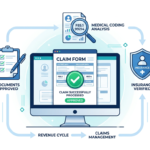
Your Clearinghouse Is a Critical Operational Partner
A healthcare clearinghouse connects your billing system with payers, helping transmit claims and exchange other administrative transactions. When that connection becomes unreliable, the consequences reach beyond the billing department: staff spend more time resolving exceptions, payment posting slows, and cash-flow forecasting becomes harder.
Yet switching vendors creates its own risks. A new connection may work for claims while electronic remittance advice still arrives through the old platform. Payer enrollments may activate on different dates. Staff may lose easy access to historical acknowledgments.
The safest approach to switching healthcare clearinghouse vendors is to treat the move as a controlled revenue-cycle project—not simply a software replacement.
Start by Defining the Problem
Before requesting demonstrations, document what is not working.
Are claims being rejected because of preventable data errors, unreliable routing, or unclear edits? Are eligibility responses incomplete? Does support resolve issues, or merely acknowledge tickets?
Establish a baseline that includes:
- Claim submission volume by payer.
- Clearinghouse rejection and payer acceptance rates.
- Unresolved transaction exceptions.
- Remittance delivery and posting problems.
- Staff time spent on manual follow-up.
- Current fees and contractual commitments.
Separate clearinghouse performance from upstream registration, coding, and documentation problems. A new vendor cannot automatically fix inaccurate source data.
Evaluate Vendors Against Your Actual Workflow
A long payer list is not enough. Ask vendors to demonstrate support for your particular payers, specialties, locations, and billing system.
| Evaluation area | What to verify |
|---|---|
| Payer connectivity | Supported transactions for each important payer, not just the payer’s presence on a list |
| Integration | Compatibility with your exact EHR or practice management configuration |
| Claims visibility | Access to acknowledgments, rejection details, and submission history |
| Remittance handling | Delivery, retrieval, and posting of electronic remittance advice |
| Enrollment support | Who prepares forms, follows up, and confirms activation |
| Security and resilience | Access controls, incident response, recovery arrangements, and relevant contractual safeguards |
| Support | Coverage hours, escalation procedures, and responsibility for unresolved issues |
| Total cost | Implementation, transaction, enrollment, support, export, and termination charges |
For NP-led practices, clearinghouse expenses should be evaluated within the broader operating budget. Where physician collaboration is required, review those expenses separately using NP Collaborator’s collaborating physician cost guide. Keeping collaboration fees distinct from billing technology costs makes vendor comparisons and cash-flow planning clearer.
Ask vendors to explain how they calculate any advertised “clean claim” or acceptance rate. Clearinghouse acceptance, payer acceptance, and payment are different outcomes.
Map Every Transaction Before Moving It
Inventory claims, eligibility checks, claim status inquiries, and remittances separately.
Changing a clearinghouse generally does not change your payer contracts or clinical credentialing. However, transaction enrollment and routing may need to change. Stedi’s migration guidance distinguishes these existing payer relationships from the transaction enrollments involved in a switch.
Maintain a migration tracker showing each payer, provider or billing entity, transaction type, enrollment status, effective date, and responsible owner.
Do not assume electronic funds transfer must move simply because remittance delivery changes. Verify payment arrangements independently.
Test the Full Transaction Lifecycle
Successful file transmission is only the beginning.
Use controlled testing to confirm that:
- The billing system produces the expected claim data.
- The new clearinghouse processes and routes the submission correctly.
- Available payer acknowledgments are received and understood.
- Rejections reach the correct staff worklist.
- Remittances can be retrieved and posted accurately.
- Payment information can be reconciled with the corresponding remittance.
Include representative cases such as corrected claims and secondary claims where relevant.
Do not submit the same live claim through both vendors simply to compare results. Parallel operation should use clearly assigned claim batches or payer groups to prevent duplicate billing.
Pay Special Attention to Remittance Enrollment
Electronic remittance advice, or ERA, can become a hidden migration bottleneck.
As enrollments change, some payers’ remittances may arrive through the new clearinghouse while others continue through the old one. Stedi’s guidance specifically describes this split period and the need to track it payer by payer.
Tell payment-posting staff exactly where each remittance should arrive. Reconcile expected remittances against received files so missing information does not silently become an accounts-receivable problem.
Use Readiness Criteria, Not an Arbitrary Deadline
A target date helps organize work, but it should not override unresolved operational risks.
Move each payer or provider group when the required enrollments, testing, training, and escalation arrangements are ready. Keep appropriate access to the previous system until historical records and outstanding transactions have been addressed.
Define rollback procedures before launch. Identify who can pause the migration, which transactions can return to the previous route, and what payer restrictions apply.
Monitor Closely After Cutover
Compare performance with your baseline. Review rejected claims, missing acknowledgments, remittance gaps, unposted payments, and aging receivables.
Avoid immediately resubmitting claims that appear missing. Check their status first to reduce duplicate submissions.
The Bottom Line
A successful clearinghouse transition is measured by continuity: claims remain traceable, remittances reach the right team, and payment exceptions are resolved quickly.
Choose the vendor that fits your real workflow, verify each transaction path, and expand only after the evidence supports it. A disciplined migration can reduce avoidable disruption, although no vendor should promise that every operational risk disappears.